South Hills Academy
West Covina · Est. 1957
Now Accepting 2026–2027 Applications — Scholarships for qualifying High School students & Sibling Discounts. Apply today
Home / Academics / High School
High School

A Competitive Edge for University Admissions

A rigorous UC A–G curriculum, 31 AP courses, and a 1:4.7 faculty-to-student ratio — preparing graduates for top universities and real-world challenges.

UC A–G Aligned Diploma31 AP Courses1:4.7 Faculty–Student Ratio
31
AP Courses
1:4.7
Faculty–Student Ratio
18
Average Class Size
90%
Admitted to Top-50 Universities
A–G
UC-Aligned Diploma
Why SHA High School

Six Reasons Families Choose Us

From a rigorous AP curriculum to a job-ready trades pathway, every student finds a path that fits — and a school that supports it all the way through.

The Diploma Path

A Direct Path to UC A–G Admissions

Complete 24 courses over 3 years to earn an SHA High School Diploma that meets the UC A–G Admissions Requirements — paving the way to top universities.

  • UC A–G aligned graduation requirements
  • College counseling and SAT/AP testing support on campus
  • Honors and AP tracks in every core department
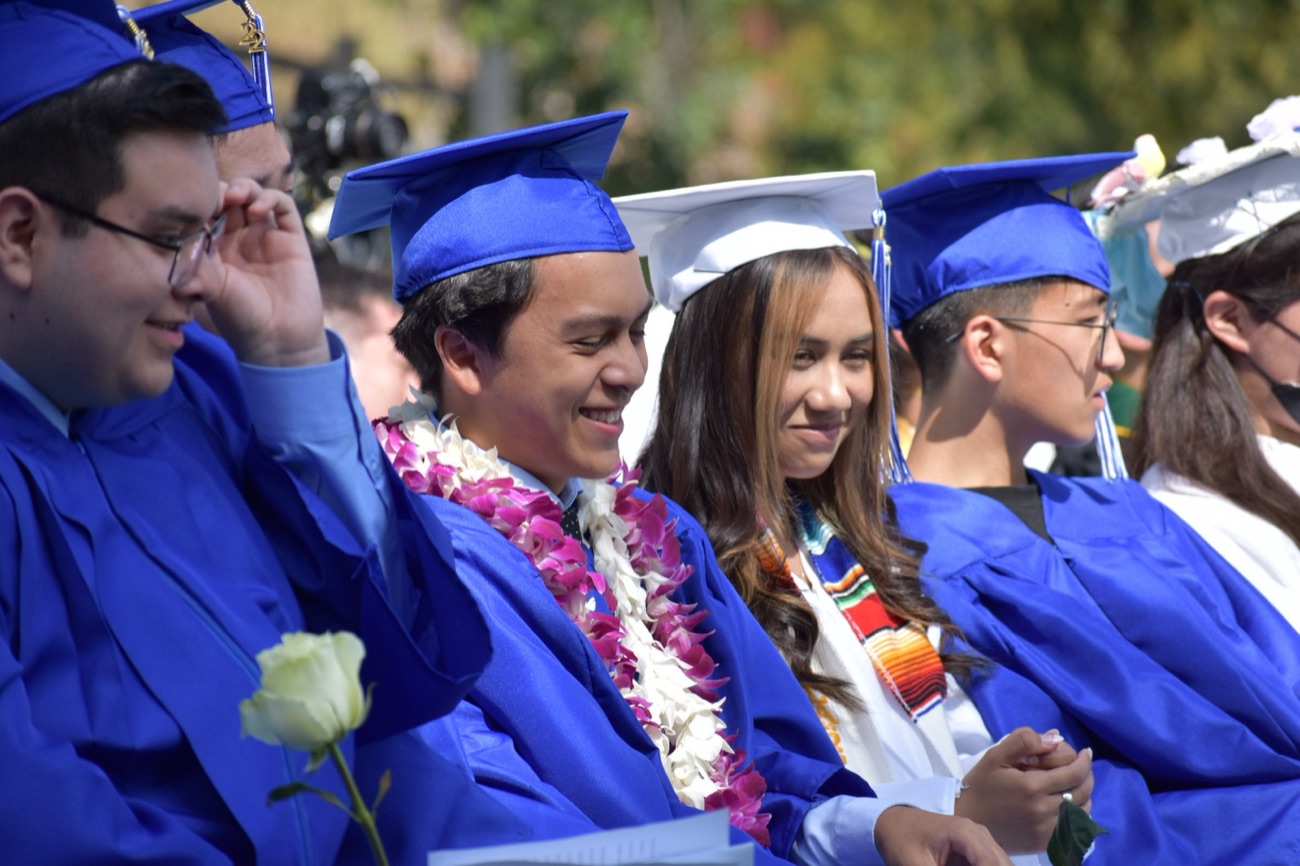
SHA graduates
UC A–G Requirements

Built Around the UC A–G Pathway

These are the University of California A–G subject requirements — the gateway to UC, CSU, and competitive universities nationwide. SHA's diploma meets every one. Open any subject area to see the courses we offer; AP marks an Advanced Placement course.

AHistory & Social Science2 years requiredOur courses
World History Track
U.S. History Track
Government Track
Also Offered
World History — A survey of human civilization from the ancient river valleys through revolutions, industrialization, and the modern global order. Students map trade routes, debate turning points, and write short analytical essays grounded in maps and primary documents. The course builds the reading and note-taking habits students carry into U.S. History and beyond.
World History Honors — The same global sweep at a faster pace and greater depth, tracing how empires, belief systems, and economies shaped one another across continents. Students work extensively with primary sources, lead seminar discussions, and write thesis-driven essays on a regular cycle. Honors World History prepares students directly for AP-level history and college seminar work.
AP World History: Modern — A college-level study of global history from 1200 CE to the present, organized around themes such as state-building, trade networks, revolution, and decolonization. Students practice sourcing, contextualization, and comparison while writing document-based and long essays weekly. The course culminates in the May AP exam, where qualifying scores earn college credit.
U.S. History — America's story from the colonial era through the present — founding ideals, sectional conflict, reform movements, and the nation's changing role in the world. Students analyze speeches, letters, and photographs, stage structured debates, and build research projects on local and national history. The course lays the groundwork for Government and for informed citizenship.
U.S. History Honors — An accelerated pass through American history with heavier reading, richer historiography, and a focus on how historians argue from evidence. Students write document-based essays, defend positions in Socratic seminars, and complete an independent research paper. The course is the natural springboard into AP U.S. History and AP Government.
AP U.S. History — A college-level survey of American history from pre-Columbian societies to the twenty-first century, built around themes of identity, politics, work, and America in the world. Students interrogate primary and secondary sources, craft historical arguments, and write timed DBQs and long essays throughout the year. It leads to the May AP exam, where qualifying scores earn college credit.
U.S. Government & Politics — An examination of how American government actually works — the Constitution, the three branches, federalism, elections, and the rights and duties of citizens. Students track current legislation, simulate congressional hearings and mock elections, and write position papers on live policy questions. Seniors leave ready to vote, argue, and engage as informed citizens.
U.S. Government & Politics Honors — An accelerated study of American political institutions, public policy, and political behavior, with close attention to landmark Supreme Court cases. Students brief and argue cases, analyze polling and election data, and write policy memos on issues they choose. The course prepares students for AP Government and for college political science.
AP U.S. Government & Politics — A college-level course centered on the Constitution, the foundational documents, required Supreme Court cases, and how institutions, interest groups, and voters shape policy. Students argue both sides of constitutional questions, interpret real polling and election data, and complete an applied civics research project. The year culminates in the May AP exam, where qualifying scores earn college credit.
AP European History — A college-level journey through European history from 1450 to the present — Renaissance and Reformation, revolutions, world wars, and the making of modern Europe. Students analyze art, treaties, and political writings as evidence, and write document-based essays that connect ideas across centuries. The course ends with the May AP exam, where qualifying scores earn college credit.
AP Comparative Government & Politics — A college-level comparison of six political systems — the UK, Russia, China, Mexico, Iran, and Nigeria — asking why states are organized so differently and with what results. Students build country case files, analyze real election and economic data, and defend comparative arguments in writing and debate. It culminates in the May AP exam, where qualifying scores earn college credit.
BEnglish4 years requiredOur courses
Language Support
Core Sequence
Honors & AP
Also Offered
ESL 1 — A welcoming first step for newcomers to English, building everyday vocabulary, core grammar, and the confidence to speak up. Students practice real conversations, keep journals, give short presentations, and read high-interest texts matched to their level. Success here opens the door to ESL 2 and real communication across campus life.
ESL 2 — The bridge from language support into mainstream English, focused on academic reading, paragraph-to-essay writing, and classroom discussion skills. Students annotate grade-level texts, build academic vocabulary, and practice the note-taking and essay structures used in every SHA course. Students who complete ESL 2 move confidently into the core English sequence.
English 1 — The foundation year — short stories, novels, poetry, and drama paired with systematic instruction in grammar, vocabulary, and paragraph craft. Students write narratives and literary analyses, deliver speeches, and learn to back every claim with textual evidence. English 1 sets the reading and writing habits students build on for the next three years.
English 2 — A tour of world literature — voices from many cultures and eras — with a sharpened focus on analytical reading and structured essay writing. Students trace themes across texts, lead discussion circles, and revise multi-draft essays with peer and teacher feedback. Strong sophomores often step from here into the Honors track or AP English Language.
English 3 — American literature from early voices to contemporary writers, paired with the study of rhetoric and a formal research paper. Students analyze how authors and speechmakers persuade, write in a range of modes, and learn to cite and synthesize sources responsibly. The course sharpens the argument and research skills colleges expect of incoming freshmen.
English 4 — A capstone in British and world literature — from Shakespeare and the Romantics to modern global voices — with college-level composition at its center. Seniors write personal statements, analytical essays, and a substantial final paper, and lead seminar discussions of major works. Students leave prepared for the reading and writing load of freshman year in college.
English II–IV Honors — The accelerated track through the core sequence, with more demanding texts, faster pacing, and higher expectations for independent analysis. Students engage in Socratic seminars, write frequent thesis-driven essays, and complete honors-level research and creative projects. The track is designed to feed directly into AP English Language and AP English Literature.
AP English Language & Composition — A college-level course in rhetoric and argument, reading essays, speeches, journalism, and other nonfiction to see how writers move real audiences. Students analyze rhetorical choices, synthesize multiple sources into original arguments, and write and revise constantly under both timed and extended conditions. The course culminates in the May AP exam, where qualifying scores earn college credit.
AP English Literature & Composition — A college-level immersion in fiction, poetry, and drama, where close reading turns great texts into arguments about meaning, structure, and craft. Students annotate deeply, debate interpretations in seminar, and write timed and process-based literary analysis essays across the year. It culminates in the May AP exam, where qualifying scores earn college credit.
Creative Writing — A workshop course in fiction, poetry, and personal narrative where the goal is finding — and trusting — your own voice. Students draft weekly, share work in a supportive workshop circle, study craft moves from published writers, and polish pieces for a class anthology and submission to contests. Many students leave with a portfolio ready for college applications.
CMathematics3 years required · 4 recommendedOur courses
Core Sequence
Statistics Track
Also Offered
Algebra — A full-year foundation in linear and quadratic equations, inequalities, systems, exponents, polynomials, and an introduction to functions. Students solve multi-step problems daily, translate word problems into equations, and learn to check and defend their reasoning. The habits built here - precision, persistence, clear notation - carry students directly into Geometry and every math course that follows.
Geometry — A course in reasoning as much as shapes: congruence, similarity, right-triangle trigonometry, circles, area, and volume, all built on definitions, postulates, and theorems. Students write two-column and paragraph proofs, construct figures, and justify every claim with evidence - learning to argue logically, not just compute. Geometry prepares students for Algebra II and the proof-based thinking colleges expect.
Precalculus — A thorough study of the functions calculus is built on - polynomial, rational, exponential, logarithmic, and trigonometric - plus sequences, vectors, and analytic geometry. Students model real situations with functions, analyze graphs from multiple representations, and sharpen the algebraic fluency that calculus demands. Successful completion leads directly into AP Calculus AB or AP Statistics.
Precalculus Honors — Covers the full precalculus curriculum - advanced functions, trigonometry, vectors, sequences, and limits - at an accelerated pace with greater depth and less scaffolding. Students tackle non-routine, multi-step problems, present solutions to peers, and begin working with limit concepts that preview calculus. This is the recommended path for students aiming at AP Calculus BC and STEM majors.
AP Calculus AB — A college-level Calculus I course covering limits and continuity, differentiation, applications of derivatives, integration, and differential equations. Students connect graphical, numerical, algebraic, and verbal representations, justify conclusions in writing, and apply calculus to motion, optimization, and accumulation problems. Students sit for the AP exam in May; qualifying scores earn college credit at most universities.
AP Calculus BC — Covers everything in AB and extends it with parametric, polar, and vector-valued functions, advanced integration techniques, and infinite series - the equivalent of college Calculus I and II. Students work through demanding multi-part problems, test series for convergence, and build Taylor polynomial approximations. On the May AP exam, qualifying scores can earn a full year of college calculus credit.
Statistics — A practical, non-AP introduction to working with data: study design, graphical displays, measures of center and spread, correlation, and basic probability. Students collect their own data, build and critique charts, and use statistics to answer real questions about sports, health, and school life. The course prepares students for AP Statistics or for the data reasoning expected in college coursework across majors.
AP Statistics — A college-level course in the four pillars of statistics: exploring data, designing studies, probability, and statistical inference. Students design and run their own surveys and experiments, simulate probability models, and carry out hypothesis tests and confidence intervals on real data - always writing conclusions in context. Students take the AP exam in May; qualifying scores earn credit for introductory college statistics.
AP Computer Science A — A college-level programming course in Java covering objects and classes, control structures, arrays and ArrayLists, inheritance, and recursion. Students spend most of class writing, testing, and debugging real programs, then trace and analyze code the way the exam demands. The course culminates in the May AP exam, where qualifying scores earn credit for a first college programming course.
DLaboratory Science2 years required · 3 recommendedOur courses
Biology Track
Chemistry Track
Physics Track
Environmental Track
Also Offered
Biology — A full-year survey of life science: cell structure and function, genetics and heredity, evolution, ecology, and human body systems. Students work at the lab bench regularly - using microscopes, modeling DNA, and running dissections - and write formal lab reports that connect evidence to claims. Biology satisfies a UC lab-science requirement and opens the door to Chemistry and honors-level science.
Biology Honors — Covers the full biology curriculum at greater depth and speed, with added emphasis on molecular genetics, biochemistry, and data-rich labs. Students design portions of their own investigations, analyze quantitative results, and defend conclusions in formal written reports. This course is the strongest preparation for AP Biology and for students already planning on pre-med or life-science majors.
AP Biology — A college-level course organized around four big ideas - evolution, energetics, information storage and transmission, and systems interactions - from molecules to ecosystems. Students spend roughly a quarter of class time in inquiry labs, designing experiments, collecting and statistically analyzing data, and arguing from evidence. Students sit for the AP exam in May; qualifying scores earn credit for introductory college biology.
Chemistry — An introduction to matter and its transformations: atomic structure, the periodic table, bonding, chemical reactions, stoichiometry, gases, and solutions. Students work hands-on with real reactions - measuring, titrating, and observing - then write formal lab reports that link data to chemical principles. Chemistry builds the quantitative habits needed for Physics, AP Chemistry, and any lab-based college major.
Chemistry Honors — Covers the full chemistry curriculum with heavier emphasis on the mathematics - multi-step stoichiometry, thermochemistry, equilibrium, and acid-base problems. Students carry out quantitative labs where measurement precision matters, evaluate error, and defend results in formal reports. This course is the direct on-ramp to AP Chemistry and a strong signal of readiness for engineering and science majors.
AP Chemistry — A college-level course covering atomic structure, intermolecular forces, reactions, kinetics, thermodynamics, equilibrium, and acids and bases. Lab work is central: students design their own procedures, run guided-inquiry experiments such as titrations and calorimetry, and justify conclusions with quantitative evidence. Students take the AP exam in May; qualifying scores earn credit for first-year college chemistry.
Physics — A concrete, algebra-based study of how the physical world works: motion, forces, energy, momentum, waves, electricity, and magnetism. Students test predictions in hands-on labs - timing carts, building circuits, measuring collisions - and learn to reason from data rather than intuition. Physics rounds out the three-science foundation colleges like to see and prepares students for AP Physics.
AP Physics 1 & 2 — A two-year, algebra-based college physics sequence: mechanics, energy, and waves in the first year; fluids, thermodynamics, electricity and magnetism, optics, and modern physics in the second. Students design their own experiments, argue from lab data, and write clear scientific justifications - the skills the exams reward most. Students sit for the May AP exam each year; qualifying scores earn college physics credit.
AP Physics C (Mechanics / E&M) — Calculus-based college physics in two parts - mechanics, then electricity and magnetism - taken alongside or after AP Calculus. Students derive relationships with calculus, run quantitative labs on rotation, oscillation, and circuits, and solve the kind of problems engineering programs assign in the first year. Each part has its own May AP exam; qualifying scores earn credit toward the physics sequence engineering majors require.
Environmental Science — A study of how Earth systems work and how humans depend on and change them: ecosystems, biodiversity, energy resources, pollution, and climate. Students get outside and into the lab - testing water and soil quality, tracking local species, and analyzing real environmental data sets. The course prepares students for AP Environmental Science and builds the systems thinking behind fields from policy to engineering.
AP Environmental Science — A college-level, interdisciplinary course connecting ecology, earth science, chemistry, and policy to real environmental problems - land and water use, energy, pollution, and global change. Field and lab work anchor the course: students design investigations, collect and graph environmental data, and evaluate solutions with evidence. Students take the AP exam in May; qualifying scores earn introductory college science credit.
AP Computer Science Principles — A college-level introduction to the breadth of computing: programming, algorithms, data and abstraction, the internet, cybersecurity, and computing's impact on society. Students build their own apps, analyze large data sets, and complete a performance task - a working program they design and document themselves. That task plus the May AP exam determine the score; qualifying scores earn college credit, and no prior coding is required.
ELanguage Other Than English2 years required · 3 recommendedOur courses
Spanish Track
Also Offered
Spanish I — An introduction to Spanish built around the situations students actually meet: greetings, family, school, food, and daily routines, with the core grammar to support them. Class time is active - students speak in pairs from day one, act out short dialogues, and write simple messages about their own lives. By spring they can handle everyday exchanges with confidence and are ready for Spanish II.
Spanish II — Students move from survival phrases to real communication: narrating past events, describing plans, and expressing opinions across a widening range of everyday and cultural topics. Daily speaking practice, presentations, journals, and readings from the Spanish-speaking world push all four skills forward together. The course completes the two-year requirement and prepares students for AP Spanish Language & Culture.
AP Spanish Language & Culture — A college-level course conducted almost entirely in Spanish, organized around themes such as family, global challenges, science, and identity. Students interpret authentic articles, podcasts, and film; converse and write emails in simulated real-life exchanges; and deliver formal presentations comparing Hispanic cultures with their own. Students sit for the May AP exam, where qualifying scores earn college credit.
AP Spanish Literature — A seminar-style survey of essential works from Spain and Latin America, from Golden Age poetry and Don Quijote excerpts to Garcia Marquez and contemporary voices. Students discuss and write critical essays in Spanish, closely analyzing theme, style, and historical context across genres. The course caps the Spanish sequence and culminates in the May AP exam, where qualifying scores earn college credit.
AP German — A college-level German course built on authentic materials - news, film, literature, and conversation with real-world tasks. Students speak, present, and write daily, moving from concrete topics to argument and cultural comparison across the German-speaking world. Offered for students with prior German background; the course leads to the May AP exam, where qualifying scores earn college credit.
AP French — A college-level French course taught in French, exploring themes from family and identity to science and global challenges through authentic media and texts. Students debate, record spoken responses, write persuasive essays, and compare Francophone cultures with their own. Offered for students with prior French background; it culminates in the May AP exam, where qualifying scores earn college credit.
FVisual & Performing Arts1 year requiredOur courses
Music
Visual Art
Music Technology — A hands-on studio course in how modern music is actually made: recording, MIDI sequencing, mixing, and arranging with digital audio workstations. Students produce original tracks each unit, critique one another's mixes, and refine their strongest work over the year. Graduates leave with a portfolio of finished recordings and the production skills that carry into AP Music Theory or college media programs.
Music Appreciation — A listening-first tour of music from Gregorian chant to jazz, film scores, and today's charts, building the vocabulary to describe what the ear hears. Students analyze recordings, attend and review live performances, and present on composers and genres they choose. The course satisfies the arts requirement and gives every student - musician or not - a lifelong framework for engaged listening.
Concert Band — A performing ensemble for wind and percussion players of all levels, rehearsing daily toward real concerts throughout the school year. Students sharpen tone, technique, and sight-reading while learning the discipline of listening and blending within a group. Performances at school concerts, chapels, and community events build stage confidence and a record of sustained commitment that colleges notice.
AP Music Theory — A college-level study of how music works - scales, harmony, voice leading, and form - paired with intensive ear training and sight-singing. Students analyze scores, complete part-writing exercises, dictate melodies by ear, and compose short original pieces. The course prepares performers and producers for college study and culminates in the May AP exam, where qualifying scores earn college credit.
Art Appreciation — An introduction to looking closely: how line, color, and composition create meaning in works from ancient temples to contemporary street art. Students practice formal analysis, lead discussions and critiques, and complete short studio exercises that let them test each concept by hand. The course satisfies the arts requirement and builds the visual literacy that supports every field, from design to marketing.
Art of Hip Hop — An exploration of hip hop as an art form - its roots in the Bronx, its four elements, and its global influence on music, visual art, dance, and language. Students analyze lyrics as poetry, study graffiti and design aesthetics, and create their own written and visual pieces in response. The course sharpens cultural analysis and creative voice while fulfilling the arts requirement.
Studio Art 3-D Design — A making-centered studio in sculpture and three-dimensional design, working across clay, wire, cardboard, found objects, and mixed media. Students plan, build, and revise pieces through regular class critiques, learning to think about form, space, and craftsmanship like working artists. Each student finishes the year with a documented portfolio ready for advanced art study or college applications.
AP Art History — A college-level journey through 250 landmark works, from prehistoric caves and classical temples to global contemporary art. Students learn to analyze form, context, and meaning; write comparative essays; and defend interpretations in seminar discussion. The course builds the critical writing colleges prize and culminates in the May AP exam, where qualifying scores earn college credit.
GCollege-Prep Elective1 year requiredOur courses
AP Capstone Program
Electives
AP Seminar — Year one of AP Capstone, recommended for grade 10. Students investigate real-world issues from multiple perspectives, learning to evaluate sources, weigh competing arguments, and build a defensible position. Assessment happens through a team project, an individual research essay, and presentations delivered to a live audience, plus the May AP exam - qualifying scores earn college credit and open the door to AP Research.
AP Research — Year two of AP Capstone, recommended for grade 11. Each student designs and carries out a year-long original research project on a question they choose, mastering method design, data collection, and scholarly writing. The course ends with an academic paper and oral defense scored by the College Board; success completes the AP Capstone Diploma pathway and gives students a genuine research credential for college.
Journalism / Yearbook — A working newsroom where students report, interview, photograph, and design their way to a published product: the school yearbook. Staff members pitch stories, meet real deadlines, and learn layout and editing software while managing pages from concept to press. Editors gain genuine leadership experience, and every student graduates with published work to show colleges.
Public Speaking — A practical course in commanding a room: speech structure, persuasion, vocal delivery, and reading an audience. Students speak nearly every week - informative talks, persuasive addresses, impromptu rounds, and debates - with structured feedback after each performance. The confidence built here pays off in class discussions, college interviews, and every presentation that follows.
Economics — An introduction to how markets, prices, and incentives shape everyday decisions, from a family budget to national policy. Students run market simulations, track real companies and current events, and debate policy questions using data. The course builds the economic literacy expected of business and social science majors and provides a base for AP Economics.
Sociology — An examination of how groups, institutions, and culture shape the way people think and act - family, media, religion, class, and social change. Students design mini fieldwork projects, analyze real data and case studies, and present findings on questions they care about. The course develops the research and analysis skills that anchor college social science work.
Psychology — A first course in the science of mind and behavior: learning, memory, personality, development, and mental health. Students run classic experiments on themselves, analyze case studies, and apply findings to their own study habits and relationships. The course gives a rigorous foundation for AP Psychology and for one of the most popular college majors.
AP Psychology — A college-level survey of psychological science, from the biology of the brain to cognition, development, personality, and disorders. Students design and critique studies, apply research methods to real data, and connect theory to daily life through labs and demonstrations. The course culminates in the May AP exam, where qualifying scores earn college credit at most universities.
AP Macro/Microeconomics — College-level economics on two scales: how consumers and firms make decisions in markets, and how growth, inflation, and policy shape whole economies. Students model real scenarios with graphs and data, debate Federal Reserve and trade decisions, and follow live economic news throughout the year. The sequence leads to the May AP exams, where qualifying scores earn college credit and a head start on business and economics majors.
PE — A movement-based course rotating through team sports, individual fitness, and lifetime activities from basketball and volleyball to strength training. Students set personal fitness goals, track measurable progress across the year, and learn the habits of training safely and well. The course fulfills the physical education requirement while building teamwork and consistency that carry far beyond the gym.
Fitness & Nutrition — A science-based look at how the body responds to training, fuel, sleep, and stress - exercise physiology and nutrition made personal. Students design their own training and meal plans, test them over multi-week cycles, and analyze the results with real data. The course equips athletes and future health science majors alike with evidence-based habits for life.
Exploring Computer Science — A first course in computing that assumes no experience: programming fundamentals, data, web design, and how computers solve problems. Students build working projects every unit - games, apps, and simple websites - and learn to debug and iterate like developers. It is the natural on-ramp to advanced computer science and a practical credential in any college application.
Business, Marketing & Finance — A practical introduction to how businesses start, sell, and stay solvent - entrepreneurship, marketing strategy, and personal finance in one course. Students develop a real business plan, pitch it to an audience, run marketing campaigns for school events, and build a personal budget and investing framework. The course gives future business majors a portfolio-ready project and every student the money skills adulthood demands.
Plan Ahead

Your Four-Year Roadmap to College

From the first day of 9th grade to the last college decision in spring of 12th, here is the journey our counselors walk with every student — one year at a time.

9

Grade 9 · Foundation

Stage 1 of 4

Set a strong base — grades, good habits, and the people who will guide you.

  • Build a strong GPA across the UC A–G core courses
  • Move into Honors classes wherever you're ready
  • Join clubs and commit to one or two activities you love
  • Meet your college counselor and take the Holland (RIASEC) interest assessment
10

Grade 10 · Exploration

Stage 2 of 4

Stretch into your first AP courses and discover what you're great at.

  • Take your first AP course
  • Begin AP Capstone with AP Seminar
  • Sit your first AP exams in May
  • Take the PSAT
  • Go deeper in one or two activities
11

Grade 11 · Momentum

Stage 3 of 4

Go deep, step into leadership, and put your college plan in motion.

  • Add more APs — two, three, or more
  • Continue AP Capstone with AP Research
  • Take the SAT or ACT in spring
  • Sit AP exams in May
  • Build your college list and begin formal college planning
  • Step into leadership roles
12

Grade 12 · Launch

Stage 4 of 4

Tell your story and send your applications with confidence.

  • Finalize essays and request transcripts (Sept–Oct)
  • Submit Early Action / Early Decision applications (November)
  • Submit Regular Decision applications (January)
  • Weigh offers and decide (December–April) — and finish your final AP exams

Every student's plan is personal — these milestones are the shared backbone we build it on.

College Board · Offered at Fewer Than 1 in 20 U.S. High Schools

AP Capstone

AP Capstone is a two-year College Board program built on two year-long courses — AP Seminar and AP Research. Instead of one more subject to memorize, students learn to investigate real questions, build evidence-based arguments, and present like a college researcher. It's a rare, standout credential on a university application.

Year One — AP Seminar

Recommended in 10th grade.

  • Investigate cross-disciplinary questions from multiple perspectives
  • Write evidence-based research essays
  • Deliver individual and team presentations

Year Two — AP Research

Recommended in 11th grade.

  • Choose your own topic and design a year-long study
  • Carry out an independent research project
  • Defend your findings in an academic presentation

Two Ways to Be Recognized

AP Seminar & Research Certificate

Awarded for scoring 3 or higher on both AP Seminar and AP Research.

AP Capstone Diploma

Awarded for scoring 3 or higher on AP Seminar, AP Research, and four additional AP exams — a signal of true college readiness.

Signature Program · New for 2026–27

AI & STEM, Built Into the Diploma

High schoolers choose from five hands-on labs — autonomous vehicles, drones & AI hardware, Unity game development, embedded systems, and soft robotics — taught with university-trained engineers. Google Gemini and Claude are woven into everyday coursework, so students build with AI, not just learn about it.

Explore AI & STEM
AI & STEM labs at SHA
Earn College Credit in High School

Dual Enrollment

Through partnerships with accredited colleges, SHA students take real college courses while still in high school — earning transferable credit, strengthening their transcript, and exploring a major early. It's open to every college-bound student, not just one track.

Up to ~30 Transferable Credits

Accumulate as much as a full year of transferable college credit before you ever set foot on a university campus.

College Courses, SHA Support

Courses run on the college's online platform (such as Canvas), with SHA teachers and counselors supporting you the whole way.

1:1 Credit Planning

A counselor maps your credit goals to your target universities and intended major, so every course you take actually counts.

For Every College-Bound Student

Available across all pathways — strengthen your application, get ahead on your degree, and test-drive a field before you commit.

Want a free head start? Full MIT, Harvard & Yale courses are open to every SHA student in our Course Library →

How It Works

Academic Assessment

We start by reviewing your transcript, GPA, and readiness for college-level work — then talk through the colleges and majors you're aiming for, so the plan fits you.

A quick records review with your college counselor

Build a Credit Path

Together we map the dual-enrollment courses that fit your goals and target universities, so every credit you earn actually counts toward your degree and your application.

A personalized credit plan mapped to your target schools

Complete Online Courses

Take real college courses on the college's online platform (such as Canvas), with SHA teachers and counselors supporting you the whole way — right alongside your regular high-school schedule.

College courses · SHA support · alongside your HS schedule

Track Credits & Progress

We monitor your progress every term and keep your transcript on target — so you arrive at university with as much as a full year of transferable credit already in hand.

Up to ~30 transferable credits before college

How credits transfer depends on the receiving university, major, and course — our counselors help you plan a path that holds up.

New · Career Pathways

College-Bound — or Career-Ready on Day One

We are building a hands-on Building & Construction pathway for the upper grades, so students can graduate ready to step straight into paid work — while every course stays UC A–G aligned, keeping college fully open.

Job-Ready Certifications

Industry-recognized credentials such as OSHA-10 that employers accept on a real jobsite from day one.

Real Mentors & Projects

Hands-on design-and-build projects with working architects, builders, and engineers.

Stackable Credentials

Trade certifications that stack toward apprenticeships — and pair with Dual Enrollment for college credit at the same time.

Straight to Paid Work

A direct line into paid apprenticeships and skilled-trade careers that pay well right after graduation.

A Promise to Every Student

A Test Center Built Around You

As an official AP exam center, SHA students test right here on campus — no scrambling for a seat at another school. And our commitment goes further: even if just one student needs a course or an exam, we will make it happen. Small classes and real attention mean your path is never too small for us to support.

An Official AP Exam Center

SHA is an authorized College Board AP exam site. Students sit their exams on a familiar campus, with their own teachers nearby — no extra travel, no unfamiliar room, no parent scramble for a seat elsewhere.

Built Around Every Student

If one student needs a course, an AP, or an exam, we open it for that student. Our small classes and "see every child" philosophy mean your choices are supported all the way through — your path is never too small for us.

Block Schedule

Longer Blocks, Deeper Focus

SHA High School runs on a block schedule, the same Monday through Friday — longer class periods mean fewer transitions, deeper focus, and time to finish labs, essays, and problem sets in class with the teacher right there.

Deeper Focus

Extended blocks let students go past the surface — full labs, full drafts, and real discussion in a single class.

Fewer Transitions

A lighter daily course load means less switching and more momentum on each subject.

College-Style Rhythm

Longer blocks mirror university classes — building the time-management habits college demands.

High School · Grades 9–12
8:15 – 9:50
Block 1Periods 1–2
9:50 – 10:05
Break
10:10 – 11:45
Block 2Periods 3–4
11:45 – 12:25
Lunch
12:30 – 2:05
Block 3Periods 5–6
2:05 – 2:40
Homeroom & Clubs
2:45 – 3:30
Block 4Period 7
3:30
Dismissal

One consistent schedule, Monday through Friday.

Beyond the Classroom

More Than a Transcript

Two tracks that round out a college-ready student — academic exposure that strengthens applications, and a heart for culture and service.

Academic & College Track

  • University campus visits and college tours
  • On-campus college counseling and application support
  • AP exams, SAT/ACT prep, and academic competitions
  • Guest speakers and career exploration

Culture & Community Service

  • Community service and volunteer projects
  • Cultural celebrations and student-led clubs
  • Service-learning and giving-back initiatives
  • Leadership, arts, and performance opportunities
Guidance & Self-Discovery

Know Yourself, Then Choose Your Path

Before students choose courses, colleges, or careers, we help them understand how they are made. Through advisory, every student explores their own interests and strengths — a starting point for conversation, never a label.

Career-Interest Discovery

Using the research-based Holland (RIASEC) interest framework — the U.S. Department of Labor's O*NET profiler — students map their interests across six areas and connect them to courses, clubs, and real career paths.

Strengths, Not Labels

Every result is a mirror and a conversation — a way to discover the gifts God has given each student, not a box to put them in.

Built Into Planning

Interests are revisited each year and woven into one-on-one college and career counseling, so each student's plan grows with them.

Plan Your Path to College

Meet our counselors and map out the four-year journey.

Get In Touch

Request Information

We're offering Scholarships for qualifying High School students and Sibling Discounts — ask us how to apply.

We respond within one business day. Prefer to talk? Call +1 (626) 919-2000 or email admissions@shacademy.org.

Book a Tour Apply Now